
Upcoming Webinars
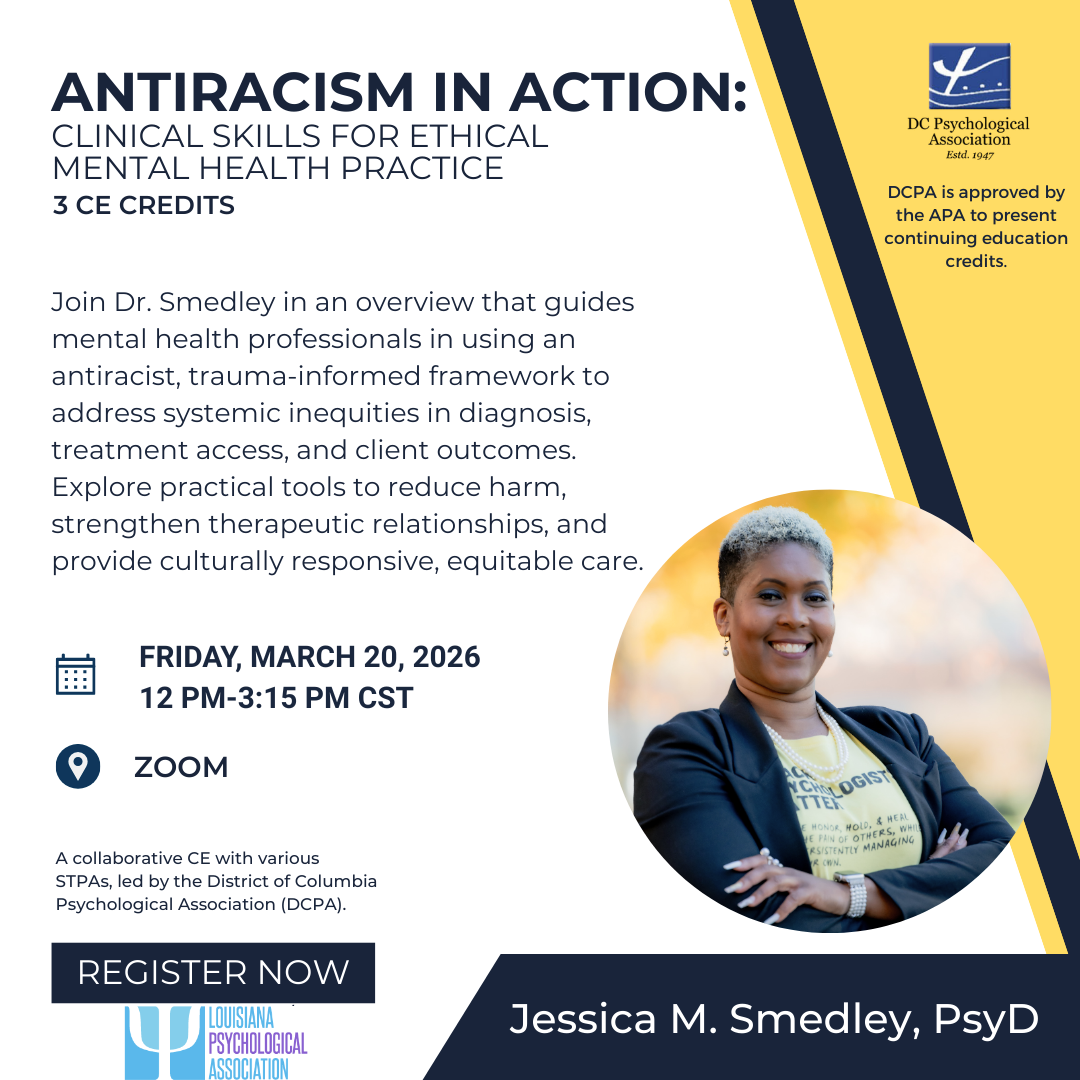
Antiracism in Action: Clinical Skills for Ethical Mental Health Practice (Webinar)
Presenter: Jessica M. Smedley, PsyD
APA approved for 3CE
LIVE WEBINAR – Friday, March 20, 12-3:15 pm
Platform: Virtual through Zoom
NOTE: This webinar was originally scheduled for March 6 and rescheduled to March 20. This webinar will also be recorded for on-demand viewing.
Presentation Overview:
Program Description
Dr. Smedley will present an overview that guides mental health professionals in using an antiracist, trauma-informed framework to address systemic inequities in diagnosis, treatment access and client outcomes. She will explore practice tools to reduce harm, strengthen therapeutic relationships and provide culturally responsive, equitable care.
About the Speaker:
Jessica M. Smedley, Psy.D. Is a native of the San Francisco Bay area. She has a long history of providing direct care and psychological evaluations to adults, children and families. Dr. Smedley completed her doctoral degree in Clinical Psychology at Fuller Theological Seminary in Pasadena, CA, where she also completed two additional Masters Degrees in Christian Leadership and Clinical Psychology. Dr. Smedley holds adjunct faculty appointments at George Washington University and Howard University.
Dr. Smedley has facilitated several workshops and trainings on mental health education and wellness, mental health stigma, racial trauma and general self-care and wellness. She has also provided expert insights for the media including NBC4 Washington, BCN News, Essence Magazine, AARP Sisters Column, Associated Press and various radio stations.
Dr. Smedley has served as the Ohio Psychological Association Diversity Committee Chair and as a Past-Diversity Liaison/Diversity Subcommittee Chair for the 2020 APA Practice Leadership Conference. She has served a three-year term on the APA Board and was recently appointed to the APA Advocacy Coordinating Committee which recommends advocacy priorities to APA. Dr. Smedley is active with the DC Psychological Association and served as the President Elect in 2023. She represented the DCPA as APA Council Representative from 2021-2023. Dr. Smedley helped to co-launch an initiative with fellow licensed healers of the Association of Black Psychologists with the long-term goal of providing support to members of the community impacted by health disparities.
Learning Objectives:
More information coming soon.

PSYPACT Ten Years After: Pathways to Interjurisdictional Practice (Webinar)
Presenter: Nanci C. Klein, Ph.D.
APA approved for 3CE
LIVE WEBINAR – Friday, March 13, 10 am-1 pm
Platform: Virtual through Zoom
NOTE: This webinar will be recorded for on-demand viewing.
Presentation Overview:
Program Description:
The Psychology Interjurisdictional Compact (PSYPACT) was legislated first in Arizona in 2015. Ten years later, PSYPACT has expanded to include 43 U.S. states and territories, allowing licensed psychologists to provide telepsychology and temporary in-person psychological services across borders. In 2025 four additional states (Hawaii, Iowa, Massachusetts, and New York) introduced PSYPACT legislation which has not yet been enacted; Alaska and New Mexico have pre-filed PSYPACT bills in 2026. This workshop will review historical drivers and legal foundations of PSYPACT, explain current PSYPACT requirements, privileges, and limitations, and discuss new pathways established by the PSYPACT Commission in 2025 to meet the educational requirements for the E.Passport and Interjurisdictional Practice Certificate (IPC). In addition, legal, ethical, clinical practice considerations, and risk management issues will be identified and explicated.
About the Speaker:
Dr. Nan Klein has served as the Utah Psychological Association (UPA) Director of Professional Affairs (DPA) for over 29 years, stepping down from this role at the end of 2025. She currently serves as UPA’s Professional Affairs Consultant. As DPA, Dr. Klein managed the unanimous passage of the Psychology Interjurisdictional Compact (PSYPACT) in the 2017 Utah legislative session. With PSYPACT’s passage, Utah became the second state to join the national compact to regulate the practice of telepsychology and the time-limited practice of face-to-face psychology services across state lines. Dr. Klein is the recipient of multiple awards for her advocacy on behalf of Psychology. Most recently, in February, 2024, she was awarded the fourth ever Lifetime Advocacy Award from the American Psychological Association.
NOTE: This webinar will be recorded for on-demand viewing.
Learning Objectives:
Participants will be able to:
- Describe the historical drivers and legal foundations of PSYPACT.
- Explain current PSYPACT requirements, limitations, and new pathways to meet educational requirements.
- Understand legal, ethical, and risk management issues.
- Evaluate whether PSYPA